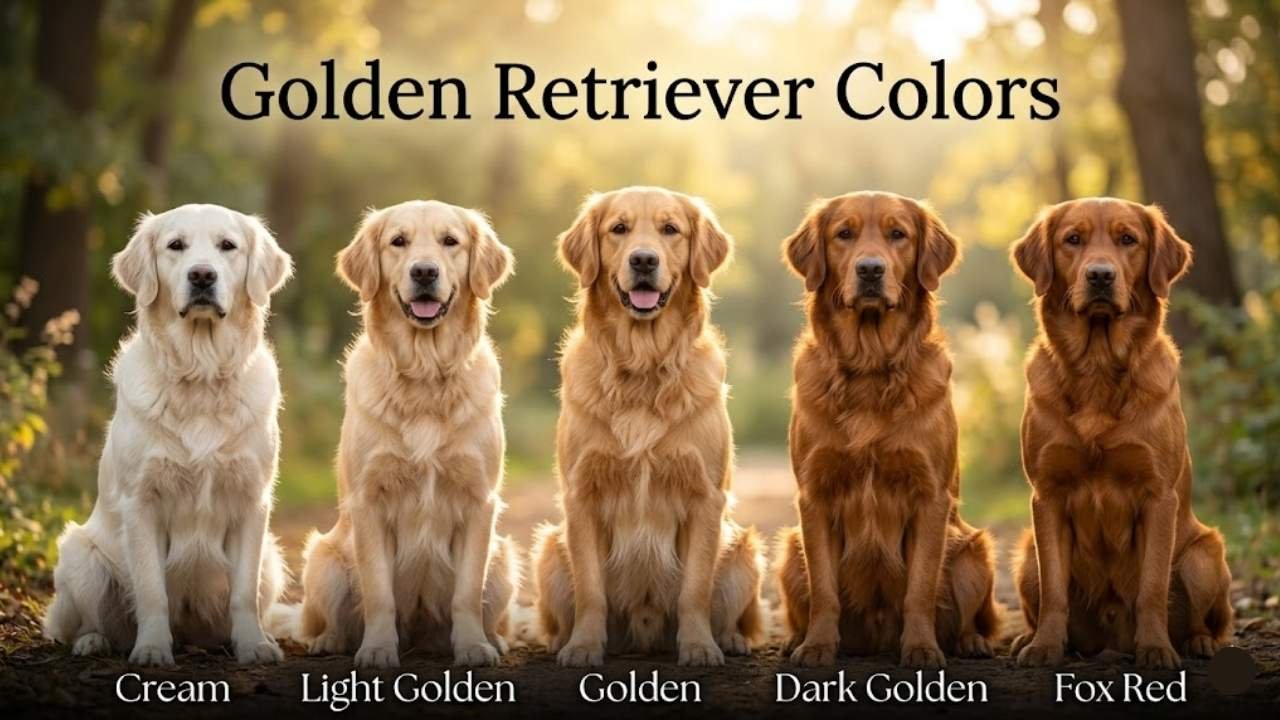

Ask ten different people to picture a Golden Retriever and you will get ten slightly different mental images. Some will picture a pale, almost white dog with a calm, blocky face. Others will picture a rich, amber-coated dog bounding across a field. Someone else might describe the deep copper tones of a dog that looks more like a fox than what most people consider a traditional Golden.
They are all Golden Retrievers. And the difference between them comes down to coat color — one of the most misunderstood topics in the breed.
There is a lot of confusion around golden retriever colors, fuelled partly by marketing from breeders, partly by kennel club standards that differ between countries, and partly by the fact that these dogs genuinely do come in a wider range of shades than their name suggests. This guide cuts through all of that and gives you a clear, honest picture of every coat shade — what it is, what it means, and what it does not mean.
Why Coat Color Matters (And Why It Does Not)
Before diving into the shades themselves, it is worth being upfront about something: coat color has no meaningful effect on a Golden Retriever’s personality, temperament, or capacity to be a wonderful dog. A cream Golden Retriever is not calmer than a red one. A dark golden is not more energetic than a light golden. These are myths, often quietly encouraged by breeders marketing certain shades as premium or rare, and none of them hold up to scrutiny.
What coat color does affect is show eligibility. The American Kennel Club and the UK Kennel Club have specific breed standards that define acceptable shades for competition. If you plan to show your dog, color matters. If you are looking for a companion, a therapy dog, or a family pet, it is the last thing you should be focusing on.
That said, understanding golden retriever colors is still genuinely useful — both for knowing what to expect as your dog grows and for cutting through the marketing language that surrounds certain shades.
The Genetics Behind the Coat
You do not need a biology degree to understand this, but a little context helps.
All Golden Retrievers carry a recessive red gene combination — what geneticists refer to as the e/e genotype at the E locus. This is the gene responsible for producing the yellow-to-red pigmentation range that defines the breed. What varies between individual dogs is the intensity of that red pigment.
Dogs with low red intensity end up with cream or pale gold coats. Dogs with moderate intensity look like the classic golden shade most people associate with the breed. Dogs with high red intensity produce the deep, burnished coats that some people describe as mahogany or copper.
This is also why coat color can shift significantly in the first two years of a dog’s life. Puppies often look lighter than they will as adults, and a dog’s feathering — the longer hair behind the ears, on the legs, and on the tail — is frequently a better predictor of adult color than the main body coat. A useful rule of thumb is to look at the tips of the puppy’s ears. The color there tends to be close to what you will eventually see on the adult dog.
The Full Spectrum of Golden Retriever Coat Colors
Cream
This is the lightest shade in the spectrum — an off-white or pale ivory coat that sits at the very edge of what most kennel clubs consider acceptable, and beyond the edge of what some will recognise at all.
Cream Golden Retrievers are significantly more common in the United Kingdom and across Europe than they are in the United States. This is largely because the UK Kennel Club accepts cream as a standard color. Their breed standard explicitly states that the coat should be “any shade of gold or cream, neither red nor mahogany.” That language leaves the door open for lighter dogs in a way that the American standard does not.
The AKC is more restrictive. Their standard specifies a “rich, lustrous golden of various shades” and states that a predominant body color that is “extremely pale” is undesirable. In practice, this means cream-coated dogs can be registered with the AKC — they are still purebred Golden Retrievers — but they will not fare well in the American show ring.
These dogs are often marketed as English Cream Golden Retrievers, and you may also see them advertised as “platinum” or “white” Golden Retrievers. Both of those labels are essentially marketing language. There is no recognised platinum or white variety of the breed. Cream is cream, and a reputable breeder will call it that.
One thing worth noting: the blocky head, stockier build, and calmer reputation often associated with English Cream Golden Retrievers have more to do with the European bloodlines they tend to come from than with their coat color specifically. Those traits are type characteristics, not color characteristics.
Light Golden
Step one shade up from cream and you reach light golden — a warm, pale yellow shade that sits within the accepted range for the AKC. These dogs have a noticeably golden tone rather than the near-white of cream, but they are still on the lighter end of the spectrum.
Light goldens are relatively common, and they are the shade many people associate with the breed’s most photogenic look — sunny, bright, and luminous in good light. In terms of show eligibility, they fall comfortably within the AKC standard, though judges have historically favoured richer gold shades over the paler end of the acceptable range.
Golden
This is the archetypal shade — the warm, rich, medium-gold colour that gave the breed its name. These dogs look exactly like what comes to mind when most people hear the words Golden Retriever. They sit comfortably in the middle of the acceptable AKC range and tend to be the most competitive shade in American show rings.
Classic golden coats can range quite a bit in tone. Some lean toward a lighter, honey gold while others are deeper and more amber. The feathering — particularly on the neck, ears, and tail — may be slightly lighter than the body coat, which is expected and noted in the breed standard.
This is also the shade you are most likely to encounter when researching kinds of golden retrievers across the American, Canadian, and British types. All three types can produce classic golden coats, though British lines tend to run slightly lighter and American field lines often run darker.
Dark Golden
Dark golden sits at the richer, deeper end of what the AKC considers acceptable. These dogs have a burnished, almost amber-orange quality to their coat that catches light beautifully. They are warmer and more saturated in colour than the classic gold, stopping just short of the copper-red shades that push beyond the breed standard.
The AKC breed standard does permit dark golden but notes that a “predominant body color which is extremely dark is undesirable.” In practice, this creates a somewhat subjective boundary between a dark golden that is show-eligible and one that has crossed into territory judges would mark down.
Dark golden coats are particularly striking on dogs with golden retriever long hair — the feathering takes on a rich, layered quality that many owners find incredibly beautiful. The longer the coat, the more pronounced the variation in tone between the inner coat and the lighter, wispy edges of the feathering.
Red
This is where things get interesting. Red Golden Retrievers — sometimes called fox-red or setter-red — have a deep, rich copper coat that sits well outside what either the AKC or the UK Kennel Club considers standard. The AKC standard explicitly states the coat should not be “extremely dark,” and the UK standard rules out red and mahogany tones explicitly.
Despite this, red Golden Retrievers are unquestionably purebred dogs. They are registered with the AKC — typically under the “dark gold” designation since there is no formal red category — and they are becoming increasingly popular as companion dogs, even if they cannot compete successfully in conformation events.
The red haired golden retriever is closely associated with field-bred lines. Field dogs are bred for working ability rather than appearance, and over generations of selecting for athletic, high-energy hunting companions, many field breeders have ended up with dogs that trend darker. A red or deep mahogany coat on a slender, fast, intensely driven dog is often a sign you are looking at a field-bred Golden rather than a show line.
This matters because the temperament and energy levels between field and show lines can differ meaningfully. A field-bred red Golden is typically higher drive, more intense, and needs more physical and mental stimulation than a show-bred dog of any colour. If you are considering a red Golden, it is worth understanding what type of dog you may be getting.
What the Breed Standards Actually Say
There is a persistent myth that certain coat colours indicate a mixed breed or that very light or very dark dogs are not “real” Golden Retrievers. None of that is true.
The AKC standard accepts light golden, golden, and dark golden. Cream and red are not disqualifying faults — they are simply designated as undesirable for show purposes. A cream or red Golden Retriever is a purebred dog in every meaningful sense.
The UK Kennel Club is more permissive on the lighter end, accepting cream as a standard colour, but equally strict about ruling out red and mahogany. The FCI — the international federation governing kennel clubs in most of Europe and beyond — also lists cream as a standard colour.
What this means practically is that the acceptable range for coat colour depends entirely on where the standard you are referencing comes from. There is no single universal answer to the question of what a “true” Golden Retriever looks like in terms of colour, because the breed standards themselves disagree.
Coat Colour and the Double Coat

Whatever shade your dog carries, every Golden Retriever has the same underlying coat structure — a dense, water-repellent double coat consisting of a soft, thick undercoat and a firmer, slightly wavy or straight outer coat.
This double coat is what gives the breed its characteristic silhouette and its legendary capacity to survive cold, wet conditions. It is also what creates the need for consistent, attentive grooming.
Darker coats can sometimes make it slightly easier to spot debris, dirt, and early signs of skin irritation, while cream and light golden coats can mask these things a little more. This is a minor practical consideration rather than a major one, but it is worth being aware of.
Regardless of shade, every Golden Retriever benefits from regular brushing and bathing. Golden retriever long hair, particularly the feathering on the ears, legs, chest, and tail, is prone to matting if it is not maintained consistently. Brushing two to three times a week — and daily during shedding season — keeps the coat in good condition and gives you the chance to check for any lumps, skin changes, or irritations that might need veterinary attention.
How Colour Changes Over a Dog’s Life
One thing that surprises many new owners is how dramatically a Golden Retriever’s coat can shift during their first two years of life.
Most puppies are born looking considerably lighter than their adult colour will be. A puppy that appears almost white at eight weeks may develop into a classic gold adult. A puppy that looks light golden may deepen into a rich dark gold by the time they are fully mature. The reverse is also true — some dogs lighten slightly as they age.
As mentioned earlier, the ear tip colour is a reliable early indicator of where a puppy’s adult coat is likely to land. Breeders who have been working with the breed for years will often use this as a quick reference when discussing coat expectations with prospective owners.
As Goldens enter their senior years, you will typically see graying or whitening around the muzzle and face. This is entirely normal and expected — the AKC breed standard specifically notes that graying of the face or body is not penalised in older dogs. A senior Golden with a silver muzzle and the warmth of a lifetime behind their eyes is, if anything, more beautiful than when they were young.
The Truth About “Rare” Colours
If you spend any time looking at Golden Retriever breeders online, you will encounter listings for “rare white Golden Retrievers,” “platinum Goldens,” and sometimes even “black Golden Retrievers.”
Here is the truth: there is no such thing as a genuinely white or black purebred Golden Retriever.
Very pale cream dogs are sometimes marketed as white or platinum, but they are cream-coated dogs — common in British lines and not especially rare. Any breeder describing a dog as “white” or “platinum” is using marketing language designed to justify a premium price. The dog may be beautiful and perfectly healthy, but it is not a distinct or rare variety.
Black Golden Retrievers do not exist within the breed. A black-coated dog sold as a Golden Retriever is a mixed breed. That does not make the dog any less deserving of a loving home, but it does mean you are not getting what is being advertised.
Working with reputable breeders who are transparent about bloodlines, health testing, and breed standards is the surest way to avoid these misleading claims.
Does Colour Tell You Anything About Health?
In short, no. Coat colour is not a reliable indicator of health in Golden Retrievers.
There are anecdotal claims that darker dogs or field-bred dogs tend to be healthier, and some breeders will suggest that cream dogs from European lines have lower cancer rates. There is no robust scientific evidence to support either claim as a function of coat colour specifically. Health outcomes in Golden Retrievers are influenced by genetics, breeding practices, and environment — none of which are reliably predicted by the shade of a dog’s coat.
What does predict health is the quality of the breeding program. A responsible breeder, regardless of what colour dogs they produce, screens for hip dysplasia, cardiac conditions, eye conditions, and other heritable diseases. They will share health clearances openly and prioritise the wellbeing of their dogs above commercial considerations.
If you are researching breeds and considering the different kinds of golden retrievers — from British to American to Canadian, from show lines to field lines — understanding how coat colour relates to type is useful context. But it should always come second to health, temperament, and the quality of the breeder.
Choosing a Colour: What Actually Matters
If you are in the process of choosing a Golden Retriever and wondering which colour to aim for, the most honest advice is this: do not choose a dog based on colour.
Choose a dog based on the health clearances of the parents, the reputation and transparency of the breeder, the temperament of the puppy, and how well the dog’s likely energy level and character matches your lifestyle. A cream dog and a red dog from a conscientious breeder will both be infinitely better companions than a classic golden from a careless one.
That said, if you do have a preference — and many people do — there is nothing wrong with it. Beauty is real, and a coat colour that catches your eye is a perfectly reasonable thing to notice. Just make sure it is the last thing on your checklist, not the first.
Final Thoughts
Golden Retriever coat colour is genuinely fascinating when you understand the genetics and history behind it. From the pale ivory of cream English Goldens to the deep copper of a red haired golden retriever fresh off a hunting field, the range within this single breed is broader than most people realise.
What unites all of these dogs — across every shade from cream to dark gold — is the same loyal, warm, endlessly enthusiastic character that has made the Golden Retriever one of the most beloved breeds in the world for generations. The colour of the coat is the wrapping. The dog inside is what matters.