

Puppy care isn’t always just about feeding. It also consists of early socialization, gentle training, regular grooming, and routine vet visits. These behaviors assist your pup to live healthily, happily, and assuredly as it grows. A domestic dog’s developmental minimum should be at a minimum of 8 weeks old.
Most U.S. states require puppies to remain with their mother and littermates until at least 8 weeks of age. If dogs are separated earlier than 8 weeks, they will lack the necessary socialization from their mother and other puppies in the pack, hence increasing the chances of becoming fearful or aggressive during adulthood.
Golden Retrievers have always found themselves topping one of the top three ranked lists in the United States by the American Kennel Club since its inception. They’re extremely soft and friendly and clever and make a great family pup. But it’s in the first year of your puppy’s life that you can make that dream come true by providing high-quality care. What you do for your dog will make a difference in their life forever. This cluster guide connects directly to our complete Golden Retriever puppy guide and covers the five core pillars every new owner needs to understand.
What does good golden retriever puppy care actually look like?
The well-being of a golden retriever goes beyond food and medicine and includes things like training, socializing, and grooming. There are actually five categories of well-being—nutrition, health, training, socialization, and grooming—that your golden needs. There are links to the other areas. A well-socialized puppy has the same temperament as a goldie is known for: quiet.
The Morris Animal Foundation’s Golden Retriever Lifetime Study found evidence that there is a positive link between dogs that receive consistent early care and longer healthy lives, while also revealing that dogs with chronic health issues experienced less. That’s the largest study of dog health ever, and the results bear out what old fart professionals know: the first year in breeders’ lives is a big one.
Moreover, according to a dog-sense-certified Dr. Stanley Coren, golden retrievers are the fourth-most intelligent dog breed in the world. That’s intelligence, fast learners, but they require structure. If not, a lack of challenge results in negative behavior.
How should you feed a golden retriever puppy monthly?

Feeding your golden retriever puppy will vary with age. Give 3 to 4 small meals every day at 8-12 weeks. After 6 months, switch to two feedings a day. Always choose a 22-26 percent protein, 12-15% fat doggy system, one that may be a massive breed.
Choosing the right large breed puppy food
Never supply your golden with ordinary pup meals. Choosing the right nutrition early on is critical, and our guide to the best dog food for Golden Retriever puppies explains exactly what to look for. WSAVA global nutrition guidelines recommend balanced diets for large breed puppies to support controlled growth and prevent skeletal issues.
A huge breed dog’s skeletal system can have balanced quantities of calcium and phosphorus to prevent very fast bone growth. As golden retrievers age, their skeletal issues, because of the quick rate of bone growth, become more pronounced, including hip dysplasia in golden retrievers, which is why understanding when Golden Retrievers stop growing is import for supporting healthy development.
Be certain to test out the primary ingredient; it ought to be real meat. Protein may be discovered in chicken, pork, lamb, and fish. Avoid components; these are made up primarily of meat meal or hen derivative meal. It is mentioned that large breeds may be susceptible to dilated cardiomyopathy on grain-free food. Please see your puppy’s veterinarian before giving a grain-free weight loss plan to a huge canine.
Golden retriever puppy feeding schedule by age
| Age | Meals per day | Daily portion |
| 8 to 12 weeks | 3 to 4 | 1 to 1.5 cups |
| 3 to 6 months | 3 | 1.5 to 2.5 cups |
| 6 to 12 months | 2 | 2.5 to 3.5 cups |
| 12 months plus | 2 | 3 to 4 cups |
Portions vary by meal brand and domestic puppy weight. Always screen your puppy’s frame circumstance score. You must feel ribs without pressing too hard, but not see them. Adjust quantities; therefore, keep away from free-feeding, which results in overeating.
Need for vaccination for a golden retriever puppy.
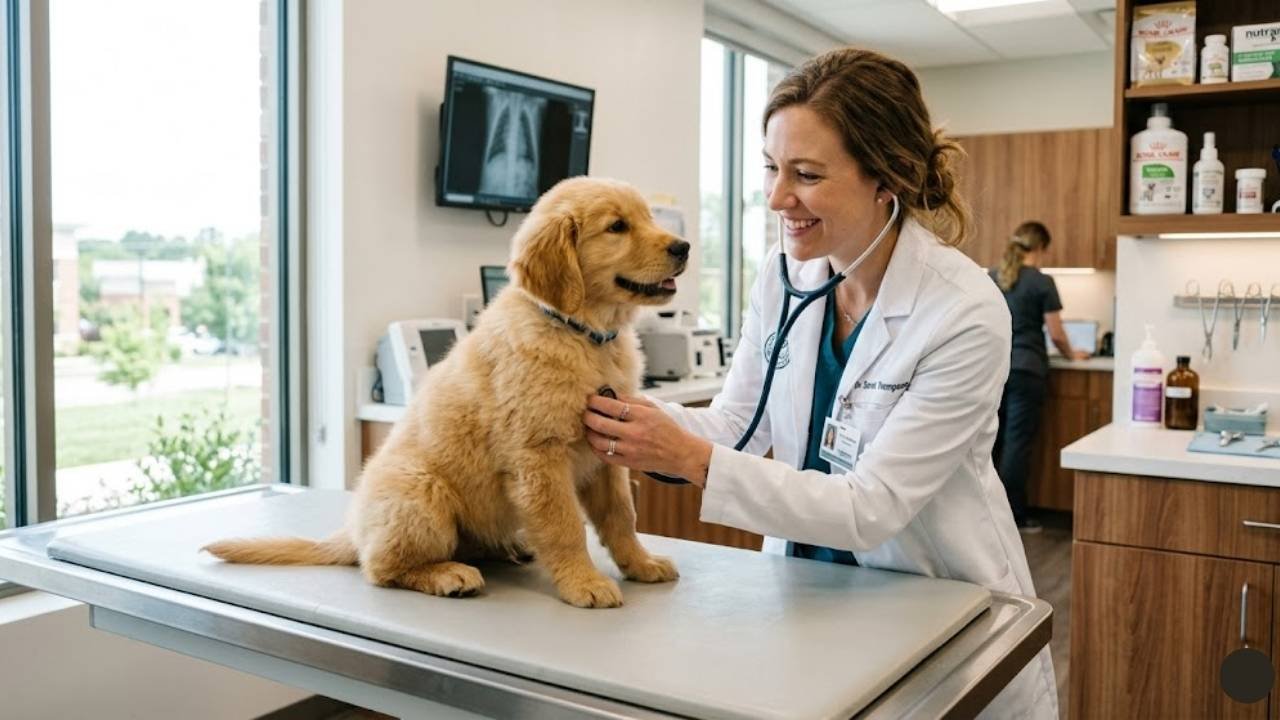
Golden retriever dogs get their core vaccines starting at 6 to 8 weeks. The timetable commonly runs every 3 to 4 weeks until sixteen weeks of age, then follows annual or triennial boosters as a person.
Essential vaccines for golden retriever puppies
Basic vaccines are those for parvovirus, distemper, adenovirus, and rabies. These are mandatory. Veterinary research posted in the Journal of Veterinary Internal Medicine reveals that 91% of unvaccinated puppies die from the parvovirus if not handled.
Non-core vaccines include Bordetella, leptospirosis, and Lyme disease. These are counseled with the aid of your veterinarian, relying on the vicinity of your location and your puppy’s lifestyle. Lyme and leptospirosis vaccines may be taken into consideration if your dog can be in wooded regions or close to water where those diseases might be spread.
Puppy vet visit schedule in year one
- 8 weeks: First DHPP vaccine, deworming, fecal exam
- 12 weeks: Second DHPP, Bordetella if needed
- 16 weeks: Third DHPP, rabies vaccine
- 6 months: Spay or neuter consultation, heartworm test
- 12 months: Annual wellness exam, booster vaccines
Beyond vaccines, heartworm prevention starts at 8 weeks and continues monthly for life. Additionally, flea and tick prevention is essential for golden retrievers that spend time outside. For more on golden retriever health care routines, the entire pillar guide covers adult health in detail.
How do you train a golden retriever puppy effectively?

Golden retrievers respond satisfactorily to advantageous strengthening. Because they’re keen to delight, food-encouraged, reward-based training produces faster consequences than correction-based methods. Start training the moment your puppy comes home, not at 6 months. Following a complete guide on how to take care of a Golden Retriever puppy can help establish the right routines from day one.
Puppy crate training basics
Crate education offers your domestic dog a secure area and speeds up residence training drastically. Choose a crate massive enough for a grown-up golden retriever, so you do not want to shop for a 2D one. Block off part of the crate with a divider while your puppy is small to prevent accidents on the return.
Place the crate in a busy location of your private home so your domestic dog feels blanketed. Never use the crate as punishment. Feed meals inside the crate and use treats to construct advantageous institutions. Most golden retriever dogs accept the crate inside one to 2 weeks after being added successfully.
Puppy obedience training milestones by age
- 8 to 10 weeks: Sit, name recognition, crate introduction
- 10 to 12 weeks: Come, stay, leash introduction
- 12 to 16 weeks: Down, leave it, basic heel
- 4 to 6 months: Distraction training, recall in outdoor environments
Golden retrievers are the fourth most trainable breed. Consequently, they pick up commands quickly when sessions stay short, around five to ten minutes, and end on a positive note.
What does golden retriever puppy grooming involve?

Golden retrievers have a dense double coat that sheds year-round and heavily twice annually during seasonal blows. Therefore, grooming is not optional; it is a core part of responsible Golden Retriever puppy ownership and an important aspect of raising a Golden Retriever puppy successfully.
Weekly puppy grooming routine
Brush your puppy three to four times per week using a slicker brush and an undercoat rake. Brushing removes loose fur, prevents matting, and distributes natural oils that keep the coat healthy. Bathing every four to six weeks with a pH-balanced, sulfate-free shampoo keeps skin healthy without stripping essential oils.
Clean ears weekly with the use of a vet-authorized ear cleansing solution and cotton balls. Never insert something deep into the ear canal. Ear infections are among the most common vet visits for the breed, and most are preventable with weekly cleansing.
Additionally, trim nails every two to three weeks. Overgrown nails modify your pup’s gait and might cause joint issues. Dental care starts early, too. Brush your doggy’s enamel 3 times weekly from the first week of domestic using dog-safe toothpaste.
How do you socialize a golden retriever puppy properly?
Socialization is the procedure of exposing your pup to new human beings, animals, environments, sounds, and surfaces throughout the vital window between 3 and 14 weeks of age. According to the American Veterinary Society of Animal Behavior, dogs that leave out ok socialization for the duration of this window are considerably more likely to develop worry-based behaviors as adults.
Furthermore, golden retrievers are prone to separation anxiety when socialization is confined to their immediate household. Expose your domestic dog to a variety of trusted people from the beginning.
Conclusion
For a large breed puppy feed formula that is 22-26 percent protein with three to four meals daily until 6 months of age, when they can be changed to 2 meals. Use a basic vaccine regimen beginning with the 6-8 week mark and continuing monthly heartworm prevention for life. Begin positive reinforcement training on the first day home; golden retrievers learn best as soon as they are 8-16 weeks old. Brush puppies 3 to 4 times a week and clean ears once a week to avoid the most common health issues in the breed. Expose your puppy to 100 people and 5 surfaces and multiple environments before 14 weeks.
Learn more about diagnosing health issues, exercise, and determining care needs for adult golden retrievers by reading more about golden retriever adult care in our golden retriever health, exercise, and senior care guide.
FAQs
Q. When is it OK for a puppy of your golden retriever to depart their mom?
The developmental minimum is 8 weeks, and the prison minimum is the longest of any U.S. kingdom within the USA. If dogs are removed earlier than eight weeks, they are deprived of social mastery from their mother and littermates; for this reason, raising the chance of developing fear and aggression in a person.
Q. What form of stage of bodily interest does a golden retriever puppy require?
Adhere to the 5-minute rule—two times a day for each month of age (5 minutes consistent with an hour of age). For a 3-month-old pup, 2 x 15 mins an afternoon is needed. It is essential no longer to overexert kids’ joints before increasing plates near the age of 12-18 years, as it may cause long-term damage.
Q. What are the everyday health problems for them?
The hip and elbow dysplasia, ear infections, pore and skin hypersensitive reactions, and weight problems. Preventing all 4 is completed with everyday vet visits, a big-breed pup weight-reduction plan, weekly ear cleansing, and element manipulation. Regular vet visits, a large breed domestic dog weight loss plan, weekly ear cleaning, and component management deal with all four preventatively.